

AMY HOROWITZ
GAY STUDENT'S UNION, ASHLAND WOMEN’S HEALTH CENTER

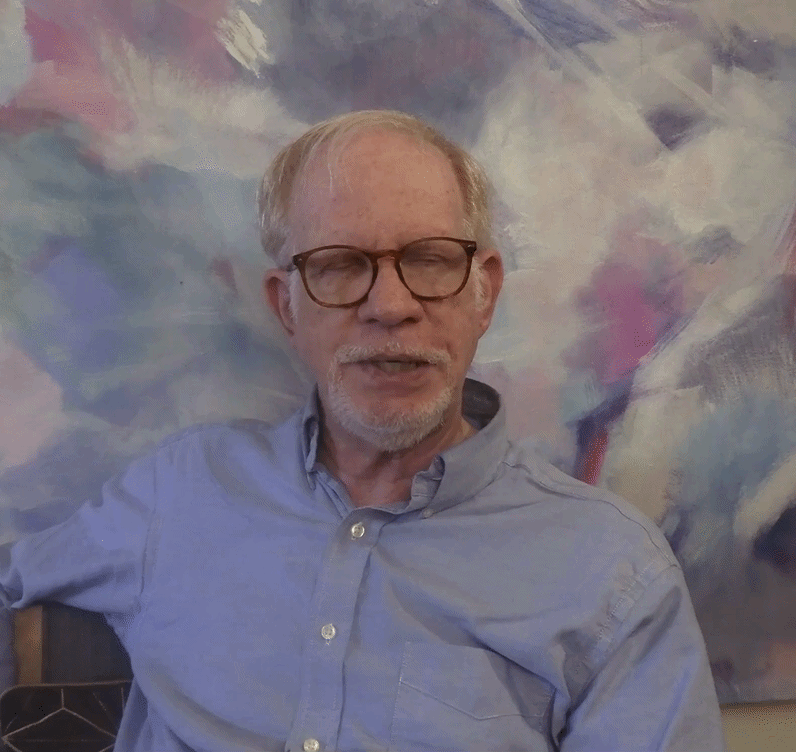
Amy Horowitz came of age politically during the women’s and gay liberation movements. She became an organizer, cultural producer, and advocate for social change. Her formalized activism started while she was a student at Southern Oregon College (renamed Southern Oregon University in 1997), focusing on women’s health and community organizing in Oregon, where she helped establish the Ashland Women’s Health Center and the Sisterspace Festival in 1972. She also co-founded the university's first gay liberation group, the Gay Student’s Union. She co-founded Roadwork and the lesbian music festival, Sisterfire, in 1971. She became deeply involved in the feminist, lesbian, Black liberation, and LGBTQ+ social movements. She collaborated with numerous performers, including Bernice Johnson Reagon. Her work demonstrates how music and culture became powerful tools for organizing and community-building. Her story reveals the often-overlooked connections between women’s liberation, lesbian feminism, racial justice, and gay liberation. It is all interconnected.
— August Bernadicou, Executive Director of The LGBTQ History Project
“I was born in Washington, D.C. I started life in a neighborhood called Anacostia, which had a mix of longtime Black families and returning World War II GIs. While I was in elementary school, my parents moved to Silver Spring, Maryland. I stayed there until I read an article in high school called A Gay Manifesto, and found out that the guy who wrote it, Carl Wittman, lived in Oregon. After graduation, I hitchhiked there.
In high school, I was a member of an organization called SDS, Students for a Democratic Society. In D.C., we were all at demonstrations, getting tear-gassed, and running—throwing tomatoes at the Pentagon and trying to stop the war in Vietnam. So my anti-war consciousness began with the Vietnam war, because that was the war that was going on at the time.
People were kind of handed an expectation of sexuality when I was coming of age—all the TV shows, The Donna Reed Show, Father Knows Best, and Leave It to Beaver and all that stuff. It was all heterosexual families like our families, and that's what we were supposed to be. I was having a much better time kissing girls. I knew that I was different, but I didn't think I was anything bad. That’s what I remember.
I didn’t really know a lesbian or a gay person. My awakening was kissing the girls and realizing I really liked it, even though I was supposed to pretend I was with a boy named David. But the next year, when I was a sixth grader, we moved, and next door to us were Mr. and Mr. Quick. Mr. and Mr. Quick said they were brothers, and they were both ballroom dancing instructors. I could see the people whispering about Mr. and Mr. Quick, and after I read A Gay Manifesto I said, ‘Oh, Mr. and Mr. Quick aren’t really brothers–they’re gay.’
I think my seventh-grade science teacher and orchestra teacher were both gay: Miss Williams and Miss Paulette. By then I had a big crush on my friend Debbie, and they kept trying to keep me apart from Debbie. We were both violinists, but they changed me to viola in the orchestra so that I wouldn't sit with her. In science, they changed me from one table to another. Our last names both started with H, so we were at the same table. They changed me to another table, but no one said to my mother, ‘We're doing this because your daughter is probably a dyke and we don't like it,’ so there was nothing overt like that. They just realized there was something too close.

I hitchhiked to Oregon. I had a pamphlet at the time called Women and Their Bodies, which became Our Bodies, Ourselves. This was an early women's thing, and they were teaching women how to manage their own health care. It was in a town called Ashland, where I could sing, start a women's health center, meet Carl, the author of A Gay Manifesto, and, with my friend Kenny, start a gay liberation group called the Gay Student’s Union at our little college, Southern Oregon College.
First-year students were required to live in a dorm, but I wanted to live with Kenny. Fortunately we found out that if you were gay—‘homosexual’ was the word used at the time—you could bypass the dorm requirement with a simple petition, because they didn't want homosexuals in the dorm.
As part of my sociology class, I started writing papers about creating a women's health center. My sociology teacher suggested I talk to the doctor in charge of county public health. He thought it was a great idea to start a women's health center, and he made me into what was then called a VISTA (Volunteers in Service to America) volunteer. VISTA, which was very much like a domestic version of the Peace Corps, so I became a VISTA volunteer, and I got trained.
I helped start the Ashland Women’s Health Center in a little closet in 1972 with some other women. That was the first thing I did. It was a horrible time for women's rights and for women's health, so we did a lot of different things. Some women came in to get pregnancy tests. We had doctors from the county public health facility come in to do examinations. Some women came to get checked for venereal diseases. There were mental health services. Some women just wanted to learn how to use a speculum so they could track their cycle for a month and see when they were ovulating and when they were not, as a way to avoid getting pregnant. The women's health center was a coalition of lesbian women like myself and very straight women, so it brought together women in Ashland and Southern Oregon during this time.
The interesting part of the Ashland Women's Health Center was that it was really a coalition of different viewpoints. Early on, I believed all the issues were connected. So I believed that stopping the war in Vietnam and later in Cambodia, what we were doing to the environment—the first Earth Day in 1970—and women's rights and women's issues were all connected. Whether it was the right to your own body, to have an abortion, to have a child, to be a lesbian, to have the same opportunities as men, all of those issues were very connected: fighting racism, fighting anti-Semitism. I saw all these issues like a tapestry—you can't pull them apart. If you pull one thread of that out, the whole tapestry falls apart. I believed that from very early on.
Through that center, I started producing concerts. Because I was very into music, I started bringing political singers to Ashland. One of the singers I brought was Holly Near, who was a lesbian for a while. She was in love with Meg Christian, who, along with Ginny Berson, founded Olivia Records. Holly Near was an anti-war singer who became a lesbian, and I brought her to Ashland. This was before the Michigan Womyn's Music Festival.
When I graduated from college, I moved to Los Angeles, and Holly hired me to help her run her record company. And this was in 1976. So one day she said to me, ‘There's a stack of records over there from all the women who have written to me and want my help,’ because she was pretty well known in the grassroots circuit. She was also a good friend of Gloria Steinem, by the way. I started listening to the LPs, and I put one on—the LP had this young Black woman's face on it. I put the LP on, and it was one of the singers I had heard when I was 11, at the March on Washington for Jobs and Freedom. Her name was Bernice Johnson Reagon, and so I decided I had to find her, kind of like when I had to find Carl. But it was easier by '76. On the back of her LP, it said that it was Folkways Recordings, which I was already familiar with. Folkways Recordings was in New York, so I tracked her down, and I found out she worked for the Smithsonian. When I went home to D.C., I met her that year, and she had just started a group called Sweet Honey in the Rock.”
Related Stories
About The LGBTQ History Project
The LGBTQ History Project is a 501(c)(3) nonprofit preserving the lives and legacies of LGBTQ+ activists from the first wave of gay liberation through oral histories, archives and the QueerCore Podcast.


Comments