

GERALD GERASH
GAY COALITION OF DENVER, CENTER ON COLFAX

Yes, folks, gay liberation was a revolution. After the Stonewall Rebellion in New York City on June 28, 1969, the Gay Liberation Front in New York City was founded. Despite what you might hear, this marked the start of a new era in the fight for gay rights: people were fighting back, and they were fighting back en masse. Before “gay liberation,” gay history consisted of interesting and isolated moments, for example, Vanguard in San Francisco in 1965. It was an important moment, but it did not spark a revolution, and it didn't spread beyond the San Francisco Bay Area. We have nearly 100 Gay Liberation Front posts on our website: Tallahassee, Florida; Lexington, Kentucky; Austin, Texas; Chicago, Illinois; and MORE.
We're telling you this because we are doing another post outside New York, Los Angeles, or San Francisco. This article features Gerald Gerash, who was a big player in Denver during the golden gay liberation revolution. In 1972, he co-founded the Gay Coalition of Denver. Emphasis on the word “gay.” Being gay was classified as a mental illness, and they were flaunting their diagnosis. “We are here, we are queer, get out of the way!” The Coalition later took on the Denver City Council to end the discriminatory criminal classification. Gerry was a lawyer and helped lead the effort.
The Denver Gay Center, called the Center on Colfax, grew out of the Gay Coalition of Denver. Gerald also helped found other organizations including the Colorado Gay and Lesbian Legal Workers and Colorado Citizens Caucus. He served on the board of the National Gay and Lesbian Task Force.
— August Bernadicou, Executive Director of The LGBTQ History Project
“I realized I was gay when I was 13. I had a wet dream of men, muscle men, actually, and my unusual brother decided to give me a sex talk. He was seven and a half years older and a student at the University of California, Los Angeles at the time. He mentioned that there are also homosexuals, and so I thought that was what I was. I borrowed his psychology book and looked up Freud and stuff, and so I knew I was gay when I was 13, but I didn't really have the opportunity to act upon it until I was 17, going on 18.
Before I left New York, there were these two brothers in the grade I was promoted to. They were all excited and wanted me to come over and be their friend, and looking back, I can see that they were probably homosexuals.
I know about the 40s and 50s. There were two different worlds. There was a straight world and a gay world, and very few straights knew anything about the gay world. In fact, that's exactly how we wanted it. That's why we had invented the word gay, so they wouldn't know what we were talking about. Although I had heard about raids on bars, I never witnessed one. I had changed my driver's license when I was a teenager. I crudely forged my driver's license so that I could get into the bars when I was 18.
Bars in Los Angeles in the 1950s were like breathing in oxygen. Suddenly everyone around you was gay, and some of them thought you were cute, or they looked at you. I saw a high school teacher there. He had been a substitute teacher, and I had a mad crush on him. And there he was at the bar. When I went up to him and said, ‘Hello, Mr. Edwards,’ or whatever his name was, he looked at me and then ran out of there like the place was on fire.
I went to the Black Cat on the weekends with some gay friends of mine, gay students, and cruised at the White Horse Bar, which is over the line into Oakland.
I was very much on the left. I was kind of a little socialist, starting in high school. So that's part of my background, and I continued being in that organization called the Labor Youth League. It was really a communist front.
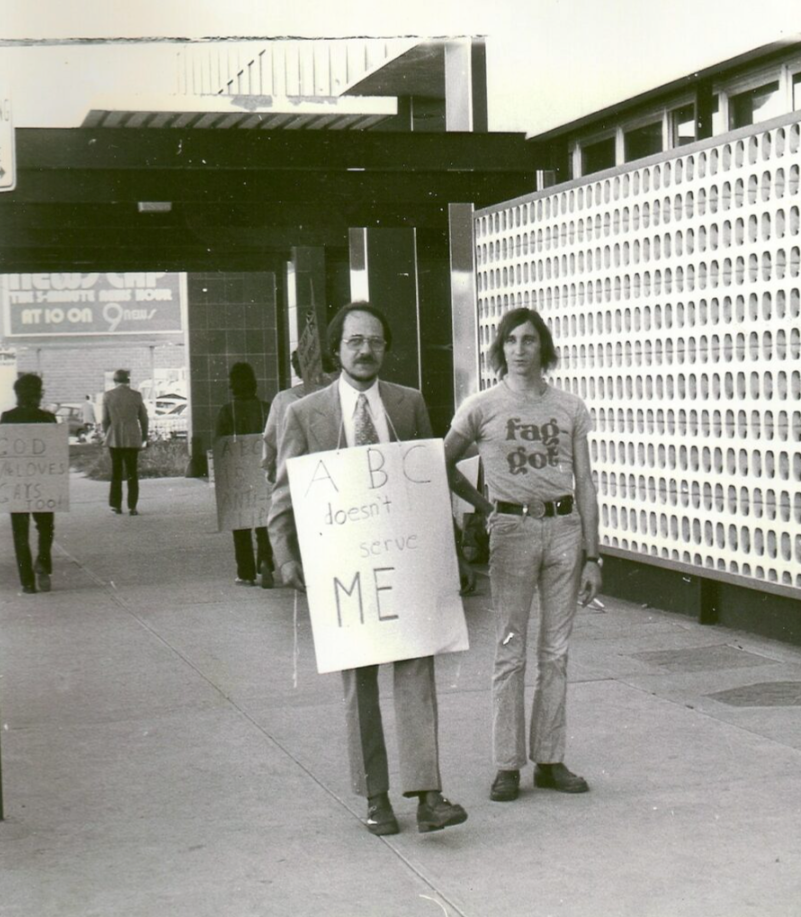
I remember there was an anti-Vietnam march, and I saw a photo of some guy holding a sign that read ‘Gay Liberation Front.’ They might have been from Boulder, Colorado. I think they had established their gay group before we did in Denver. Of course, they got funding from the university, so they were more organized and had support. Then we organized in late 1972. Four other people and I co-founded it. We named it the Gay Coalition of Denver. It was a very non-militant name, partly of my doing. We came after the Black Civil Rights Movement, the women’s liberation movement, and the gay liberation movement: it was a natural progression of anti-establishment movements seeking fairness, change, and liberation.
Terry Mangan, one of the five co-founders, said the first word had to be ‘gay,’ so they could find us in the phone book if they forgot our name. So we got the name Gay Coalition of Denver, but we grew very quickly, and we had various committees: a political committee, a telephone hotline committee. We had a coffee house at Denver Free University on the weekends and had music, poetry, and speakers. It was like our alternative to the alcohol of the bars.
We learned that gay men were illegally being arrested in January or February of 1973 by an undercover vice squad using the usual entrapment—agreeing to go home with someone. The Denver Police Department introduced a large tour bus with a marquee that read ‘Johnny Cash Special.’ The bus drove around downtown Denver in the popular gay cruising areas. Gay men were arrested, and their specific charge was offering a lewd act, and so that was impossible because they agreed to go home to commit what was now a legal act. Some of the officers were saying, ‘Do you want to go to the concert?’ Through March, 380 gay men were arrested in this stunt.
Our political committee tried to meet with city council people, and they were all very hostile and unfriendly. Let's say unfriendly. Finally, we learned they were going to review all the criminal laws. We got a favorable news article: we claimed these people were illegally arrested, and the reporter did his own investigation by going to the police department, where he found even more people than we did who had been arrested. Our main publicity was through the Rocky Mountain News and the Denver Post.
We packed the city council chambers until they were overflowing. We waited two hours or more, and then they announced we would have 30 minutes for our 35 speakers. Anyway, I was the first. I had filed a lawsuit alleging discriminatory enforcement and violation of the Fifth and Fourteenth amendments and demanding equal protection and due process of law. And as a result of that lawsuit, which was a civil case allowing very broad discovery, the judge allowed us to go into the criminal court records and research, where we found that all the people arrested were gay men. So by definition, it was discrimination. When it became my turn to speak, I brought that up—then we were allowed to speak for about an hour and a half, and it turned into like an education, like a game, like in the Vietnam War days: we got to speak about our lives and our problems as gays and lesbians.
Trans people were not involved, and that term was not used at that time, or if it was, it was just like it was one person who was involved, who was a trans person. He so happened to sabotage our news conference before the city council hearing; he came in dressed to the nines, and there was TV there. I said, ‘Look, it would be best if you leave’ because I knew that the TV would show him and wouldn't pay much attention to our news conference, our statements of protest. He agreed to leave, and we had a good press conference.
We successfully got the anti-drag law repealed at the city council hearing: men shall not wear women's clothes. We got that repealed. Then a segment of that group got very involved in forming a center. They worked with us for years, and they raised money for drag shows and so forth. So they did get involved.
The judge ordered that the Denver police shall cease all discriminatory acts against gays and lesbians, and they gave examples like holding hands in public, kissing in public, or anything that they would not arrest a heterosexual couple for doing in public—they shall not arrest gay people. It's very broad and very effective, and it basically stopped the undercover operations. That was a huge thing. It was among the first repeals of anti-gay laws in the United States.
Cordell Boyce, our director, went into detail in his testimony at City Council, as did Terry Mangan. Interestingly, at the end of that hearing, a guy followed us down to an all-night diner, and he tapped me on the shoulder. He said he was a co-owner of a bathhouse in Denver called the Club, and he came to the hearing because one of the laws that was on the books was renting rooms out for purposes of sexual activity, and anyway, he gave $2,000 to me, and we used it to open up an office. So we had the office open for about a year until we ran out of money, and the office really was like a community center because people just came in and wanted to be in a gay space and talk to someone sympathetic.
At one point, people were saying, ‘Well, let's go to the high schools, and talk to kids,’ and I took a very conservative stand. I said that we would feed into the recruiting of kids. I thought that was dangerous.
There was a custom of gay bashing, usually by young straight people. They would find gay people leaving the bathhouse, for example, or known gay places, and they would attack them. As I left the gay bathhouse at about one in the morning, I noticed two young men following me at a distance. They were gaining on me, so I started to run; they ran too, and by the time they caught up with me, I was safely inside my car. After that incident, I carried a baseball bat in the trunk of my car.
Assimilation. That word is inappropriate. I mean, if you were gay, you tried to survive as a gay person, which essentially meant being in the underground. The alternative priority was not to be recognized as a gay person. What gay people needed was a place of their own where they could map out their own future, and that's how the idea of a gay community center came about.”
Date and Interview Information
Date: Monday, September 21, 2026
Time: 1:00 PM MDT
Location: Denver, Colorado
Related Stories
About The LGBTQ History Project
The LGBTQ History Project is a 501(c)(3) nonprofit preserving the lives and legacies of LGBTQ+ activists from the first wave of gay liberation through oral histories, archives and the QueerCore Podcast.


Comments